Similar Books


jerenda librarything | 2.0 out of 5
The series was intriguing, that much I'll say. All the mystery wrapped up in the story, the cloak-and-dagger part, that enticed me into it. So did the brilliance of Violet's inventions- as a fan of Artemis Fowl, I am one who enjoys sheer brilliance in writing. Yet it was exceedingly boring at parts, like when he defines words I've known since kindergarten (okay, third grade) and especially when the story repeats itself. The ending was a let-down, far too lacksidasical for all the "this is a terrible story with a terrible ending" stuff, and it plays with the meaning of good and evil excessivly. When all was said and done, it was a rather irritating story.
hartn librarything | No Rating
I have read the first three in A Series of Unfortunate Events and am in love with the series. Like other creations that perform something similar, the magic of coming so close to explaining that the story is a written piece of fiction while simultaneously building that world of the novel so concretely in the reader's imagination is a wonder to behold.
The work that comes to mind is Italo Calvino's If on A Winter's Night a Traveler, and Spike Jones movie Adaptation, starring Nicholas Cage. In all these works the superimposition of the narrator, of the fact that we are reading a narrative, allows the writer to own that space and make the reader follow their lead. In A Series of Unfortunate Events, the foil of the dreaded boring book with its happy endings and serendipitous turns gives the Baudelaire children authenticity and the narrator the space to interpret the many ambiguities of the real world that is so often candy coated for young readers.
Lemony Snickett's interpretation of the ambiguities and sophisticated words, or the baby talk of Sunny, is what hooked me and I found myself completely lost in the telling to the point of having no idea how the Baudelaire children would survive. While very different from the author's Adverbs, his recent novel for adults, the same enjoyment and exploration of language pervades the series and infects the reader. But the children are more typically helpless in their orphaned and wretched state, and the villain is more villainous than show more any writer should be able to get away with, but it works so well!
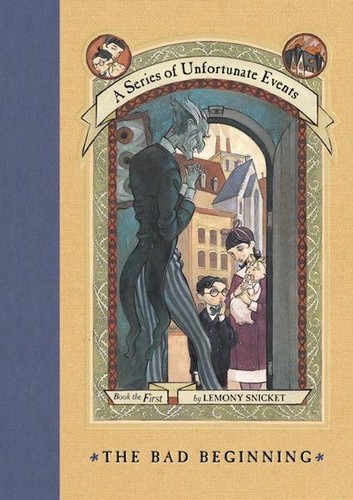
The illustrations by Helquist are reminiscent of silent movie tableaus, and the ominous moments captured in the pictures invite the reader's fearful sensibilities to keep reading while delighting their more skeptical abilities.
Krowecat librarything | 4.0 out of 5
Rating: 4.5 stars
Lindsey Daniels goodreads | 5.0 out of 5
Even better the second time around!
__Lindsey__ librarything | 3.0 out of 5
Truly this is a 3.5 star rating. I really couldn't give it anymore than that though, since this is more of just a cute tale and not any wonderfully epic book.
I enjoyed the setting - seems like it's in Victorian times with the clothing (in the illustrations at least) and the houses with large libraries, but it actually is set in more modern times.
I liked Violet and Klaus, since they were so polite and intelligent.
Sunny was just an annoying part of the book, but I guess her presence does figure into the plot at some point.
What I liked most about reading this was that it was reminiscent of Roald Dahl's books with the intelligent, lovely kids and the adults who are either absent, oblivious/unbelieving of the children, or evil.
I've started on the second one already since they're such fast reads. We'll see if the series gets anymore interesting.