Similar Books
 Fantastic Mr Fox
 Alice's Adventures in Wonderland / Through the Looking Glass
 The Canterbury Tales
 The Dragonbone Chair
 Redwall
helynrob librarything | 3.0 out of 5
i only liked this after my classroom was torn asunder by a heated debate on the protagonist. the teacher tried to play referee but, oh, how we felt things so strongly...
jimocracy librarything | 3.0 out of 5
This a well-written but bizarre story. I'm sure there's a moral or lesson in there somewhere but it has eluded me.
Jacobflaws librarything | 3.5 out of 5
Strange, but he is such a good writer.
kwohlrob librarything | 5.0 out of 5
Endlessly dissected, ripped apart, its guts laid out on a slab, sewn back together, reconstructed, reinterpreted, misunderstood, misinterpreted, parodied, plagiarized, overanalyzed, and sadly sometimes underappreciated. Kafka’s The Metamorphosis is one of those jumping off points for modern literature, a key touchstone where so many good writers -- Borges, Nabokov, García Márquez – found inspiration in his work and studied it like a textbook on great writing.
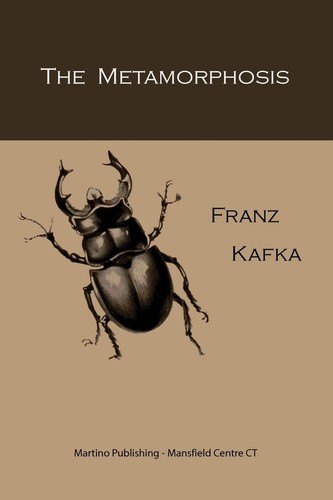
But what is the metamorphosis? A dark fantasy about a man who wakes up one day to find himself transformed into a vile insect-like creature? Or an absurdist tale of a schizophrenic who believes he’s been turned into a human-sized beetle, terrorizing his family with his decrepit mental state? Kafka left that open for us to decide, even asking his original publisher to remove any imagery involving an insect off the cover. The first edition cover (you can find it on Wikipedia: http://en.wikipedia.org/wiki/The_Metamorphosis) is not a definitive statement on the story either. Is it the afflicted Gregor Samsa we see or his unnerved father fleeing from the sight of the creature in his son’s room? As it was written in German, Kafka never definitively stated what Gregor had become. The term he used, in what has now become one of the more famous opening lines in literature, to describe Gregor’s transformation was “ungeheueres Ungeziefer,” which literally means “unclean animal not suitable for sacrifice.” show more This has been translated (and mistranslated) as “gigantic insect” in some cases, but in later years, more translators have settled on “monstrous vermin,” as this seems to suit Kafka’s vague intent much better. But if you want to read the numerous theories, Google the book. I’ll leave it to those who are far more and far less philosophical than I.
In its construction, The Metamorphosis is flawless. Kafka upends the entire structure of modern storytelling, giving us the climax first, never explaining the possible source for Gregor’s affliction. Instead, Kafka leaves us in the dénouement, showing us the ugly effects of Gregor’s transformation on his too dependent family, who must now care for this unwanted monstrosity. As the tables are turned, the family shuns Gregor, locking him away. We then see Gregor move in two opposing directions -- becoming more louse-like in his basic behavior (such as eating garbage), but also more human in his fantasies (and sudden appreciation of music). It is this complex contrast that makes Gregor seem more human to us, thus playing into Kafka’s slippery reality that confuses as much as illuminates.
And yet, The Metamorphosis is not all doom and gloom. It’s actually quite funny. Sure, it has a dark, black sense of humor, but nevertheless, you can’t help but laugh at parts. When the new house maid spies Gregor for the first time, she does not turn tail, screaming in horror like his family. She merely states, “Come over here for a minute you old dung beetle!” Or the lodgers, who upon seeing Gregor slowly crawling towards them, do not try to smash him or exit the premises. They try to negotiate out of paying rent to Gregor’s father in light of the “disgusting conditions prevailing in this apartment and family.” Even Gregor’s ultimate fate, which I won’t give away, is handled in a way that the cast members from Monty Python’s Flying Circus would certainly appreciate.
With so many layers to it, The Metamorphosis still remains one of the most studied and widely imitated novels of the 20th century. But in its purest sense, it is an amazing, perfectly crafted, dark little fable.
JennysBookBag.com librarything | 4.0 out of 5
4 stars