Similar Books



gloriavana librarything | 4.0 out of 5
Hopelessness of students resulting in usage of soft narcotics, seeing that Reality is a word used by groups to justify and validate their claims about what's Real which looks at it from only one POV and actively suppresses the other, teaching learned helplessness by blaming problems unpresented in such quantity in society before like schizophrenia as pathological or neurological problems instead of a symptom of the socio-political system (eg: Japan didn't use anti-depressants, but mass marketing campaigns made it one of the biggest consumers of it) and selling the 'cure' as pleasure which in must cases is just a numbing agent- not the solution, a desire for ease rather than quality, reduction of interpersonal relations to mutual benefit, doing according to the rules not being enough but instead being required to go far and above to be considered 'good', the meandering of beaurocracy because there's no appeal to one who controls everything but instead the default replies of, "it's not in my hands- but the rules" resulting in no work being done for you unless you've got the connections, 'self flagellation' in many academic contexts wherein you're required to constantly assess yourself generating a anxietas perpetua, the wyrd mix of neoliberalism which though anti statist only cares about it negatively affecting the economic and cultural level and neoconservatism which cares about military and police functioning, the responsiblization of factors like climate change as a show more fault of everyone (and hence no one), the state being one which goes easy on it's children and hence makes their life hard for the children grow up to be hedonists who aren't taught to think by the media and culture, but instead to feel, how a new party shouldn't take over the state but align it to the general will.
And so much more, in more detail. I, as I write, feel lacking because I didn't understand the book. So many concepts were thrown at me, so many dropped and barely stuck in my head. I'll need to read it once again to grasp it better but I am sated for now. It was a drab to get through (for me) but golly it was worth it.
rottweilersmile librarything | No Rating
i liked the marks about the media. i don't think i got all of it nor agree with all of it, a bit too "writing about nothing" for my taste
SidKhanooja librarything | 4.0 out of 5
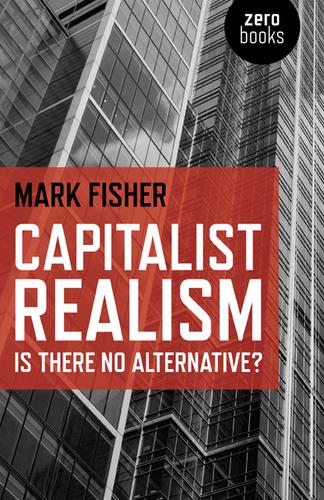
Capitalist Realism was thought-provoking and somewhat deserved its status as a classic introduction to post-Marxism.
Fisher rightly highlights how capitalism portrays itself as having no alternative, with the collapse of the Soviet Union, and terms this as inherently anti-utopian 'Capitalist Realism'. It doesn't matter that the rise of free markets means ever-increasing inequality, the demise of public education and healthcare, and growing disillusionment and apathy - all that matters is capitalism cannot be allowed to perish. Consequently, capitalism is not constrained by politics anymore - instead, political systems fight amongst themselves to carve a space within capitalism.
Fisher also highlights capitalist realism as encouraging interpassivity (or protesting capitalism through media consumption). He also tries to view mental health through the lens of his theory (coining a term called reflexive impotence). People recognise that capitalism is inherently flawed, but they also believe they can do nothing about it -leading to a lack of self-worth and depression. I somewhat disagree with this argument because not every mental health issue can be laid at capitalism's doorstep, but I digress.
It is frighteningly easy to get lost in the doom-and-gloom. Still, to Fisher's credit, he's not a (complete) doomer - he provides meaningful criticism, added on with a warning not to get too cynical about democracy and the State because what good has ever come of handing over the entire show more public sphere to the industry?
All in all, an eye-opening experience and one which I wish I had read much sooner. Must-read.
annarchism librarything | 4.0 out of 5
I’ve been meaning to read 'Capitalist Realism' for years, but only now that I’ve moved to Scotland do I find a library that has a copy. The University Library in Cambridge did not, outrageously enough. I’ve come across references to it in various other books criticising capitalism, plus it is only 81 pages long, so inevitably there wasn’t a great deal in it that felt new to me. Instead, I’d call it an impressively concise synthesis. Fisher picks certain bits of Žižek to interpret (ie make comprehensible), as well as drawing on Jameson and various older theorists. His discussion of bureaucracy brought to mind [b:The Utopia of Rules: On Technology, Stupidity, and the Secret Joys of Bureaucracy|22245334|The Utopia of Rules On Technology, Stupidity, and the Secret Joys of Bureaucracy|David Graeber|https://images.gr-assets.com/books/1417415465s/22245334.jpg|41620170], which examines a similar thesis in considerably greater depth, and [b:Present Shock: When Everything Happens Now|15811513|Present Shock When Everything Happens Now|Douglas Rushkoff|https://images.gr-assets.com/books/1355084098s/15811513.jpg|21536777], which focuses on the eternal now in which we find ourselves. The personal anecdotes about working in higher education made me think that perhaps I was too harsh on [b:Deschooling Society|223403|Deschooling Society|Ivan Illich|https://images.gr-assets.com/books/1432971875s/223403.jpg|216356].
In short, I was reminded of many things I’d already read show more without necessarily coming across anything strikingly novel. The nearest to that was the chapter titled ‘All that is solid melts into PR’, which talks about corporate language and the ‘hidden expectations behind official standards’. These certainly seem to be prevalent in academia: a clear expectation that you should work unpaid overtime, in pursuit of a more senior job that will require even more unpaid overtime. Ugh, why should I bother. The mere prospect leaches any career ambition out of my body (cf [b:How to Be Idle|623922|How to Be Idle|Tom Hodgkinson|https://images.gr-assets.com/books/1388368701s/623922.jpg|1768914] and [b:The Freedom Manifesto|603848|The Freedom Manifesto|Tom Hodgkinson|https://images.gr-assets.com/books/1410448871s/603848.jpg|590413]).
Fisher shares Žižek’s habit of referencing a fairly eclectic set of films, novels, and TV, which made for an enjoyable, readable non-fiction-equivalent-of-a-novella on anticapitalist critical theory. However, such eclecticism tends to result in somewhat uninspiring concluding chapters, and so it was here. Fisher suggests revitalising the Left by fighting bureaucracy, without articulating this nearly as well as Graeber in [b:The Utopia of Rules: On Technology, Stupidity, and the Secret Joys of Bureaucracy|22245334|The Utopia of Rules On Technology, Stupidity, and the Secret Joys of Bureaucracy|David Graeber|https://images.gr-assets.com/books/1417415465s/22245334.jpg|41620170]. I’m also unsure what he can mean by, ‘We must convert widespread mental health problems from medicalised conditions into effective antagonisms’. I’m all for carbon rationing, though, which is also mentioned. Although it was worth reading, ‘Capitalist Realism’ already feels slightly dated to me. The book I think best captures the systemic weakness of current capitalism is still [b:Postcapitalism: A Guide to Our Future|24878857|Postcapitalism A Guide to Our Future|Paul Mason|https://images.gr-assets.com/books/1437580637s/24878857.jpg|44526761].
peach_gummies librarything | 4.0 out of 5
Fascinating. The references can be a challenge as they illustrate and support the main arguments, yet I didn't know a lot of them so it was hard to make the expected connections. Otherwise really interesting ideas, I appreciated how the book built itself off preexisting theory.